
Most healthcare organizations think about downtime in terms of their EHR. When Epic goes down, or Cerner has an outage, that’s “downtime.” And they’re right, but they’re only half right.
The more dangerous scenario is network downtime: when the network itself fails, and suddenly it’s not just one system that’s unavailable, it’s everything. Your EHR. Your pharmacy system. Your lab. Your document management. Your registration workflows. All of it.
Network downtime can result from ransomware attacks, ISP failures, hardware faults, natural disasters, or even a construction crew cutting the wrong cable. And unlike planned EHR maintenance, network outages are almost always unplanned, sudden, and impossible to predict.
This is where dedicated downtime workstations, the kind dbtech deploys, become critical. Because they’re specifically engineered to operate completely independently of the hospital network.
The Difference Between EHR Downtime and Network Downtime
It’s worth being precise about this distinction, because the two require fundamentally different solutions.
EHR Downtime
EHR downtime occurs when your electronic health record system becomes unavailable, due to vendor maintenance, software failure, a cyber incident targeting the EHR itself, or an upgrade gone wrong. The network may still be operational; you just can’t reach the EHR.
Network Downtime
Network downtime occurs when the underlying network infrastructure fails. This is a broader and often more catastrophic event. Even if your EHR servers are completely intact, no workstation on the hospital network can reach them. Cloud-based systems become inaccessible. Internal communication tools fail. Lab results can’t be transmitted. Imaging can’t be retrieved.
A solution that only addresses EHR downtime, one that operates on the same network as your primary systems, offers no protection during a full network failure.
How dbtech Downtime Workstations Are Architecturally Different
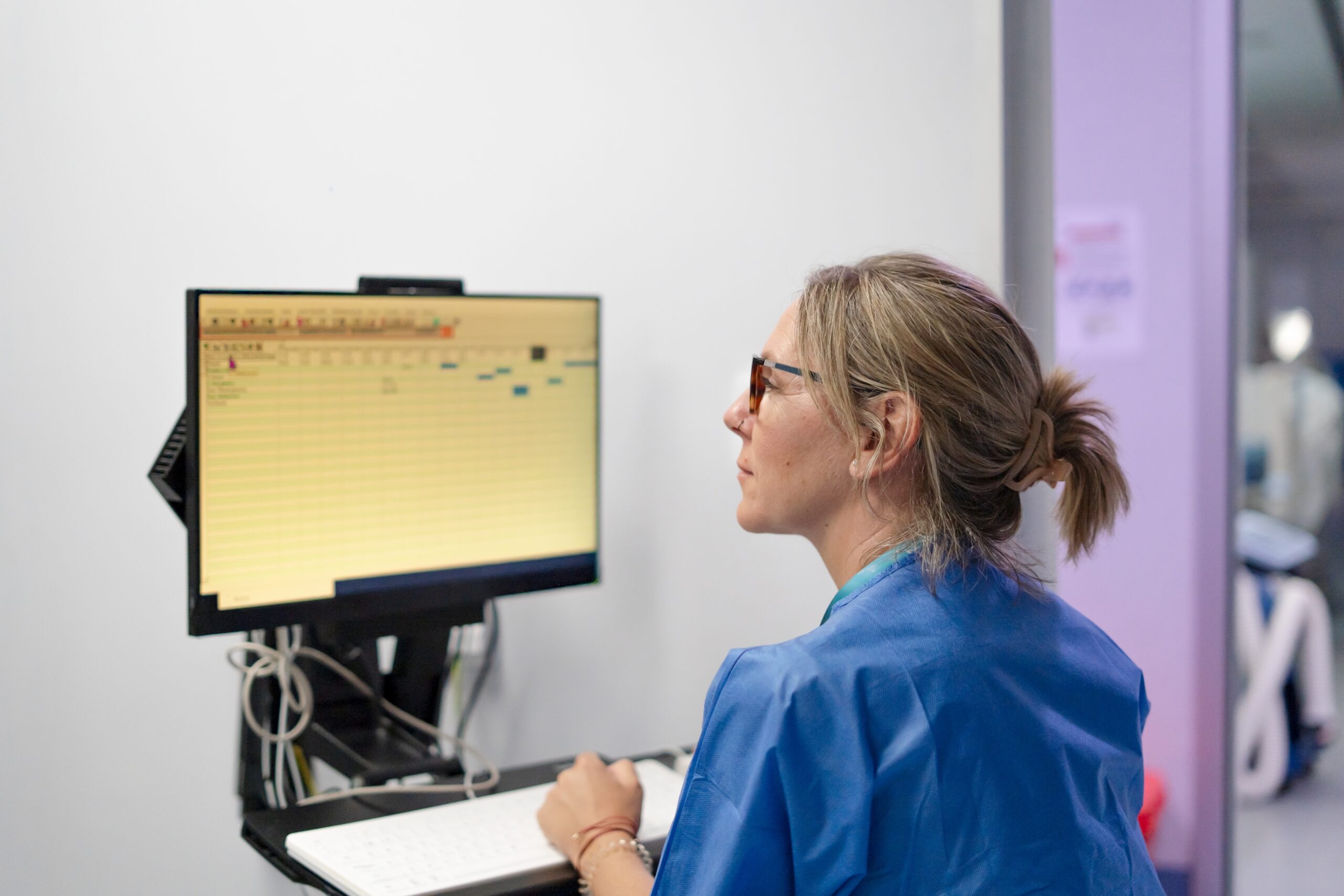
dbtech’s downtime workstations are physically isolated from the hospital’s main network. They are deployed in predefined locations, emergency department, registration, nursing units, surgical areas, and they operate independently.
During normal operations
The downtime workstations maintain a minimal network connection solely to receive continuous patient data updates from the EHR via HL7. Patient census, registration history, insurance data, and medication records are constantly synced into the local workstation database. This connection is narrow and intentionally limited.
During a network outage
The workstations function in fully offline mode. They already have the patient data they need, locally stored and encrypted, and they do not depend on the hospital network to operate. Staff can access patient records, register new encounters, complete eForms, print armbands and labels to a locally connected printer, and capture signatures electronically.
During ransomware attacks specifically
Because the downtime workstations are isolated and not in regular use on the main network, they are inherently less susceptible to ransomware propagation. Even if the primary network is completely compromised, the workstations remain clean and accessible. This is an architectural security advantage that cloud-based solutions simply cannot provide.
What Stays Available During a Full Network Outage
When the network goes down and dbtech downtime workstations are active, clinical and administrative staff retain access to current patient census, medication administration records (MAR), insurance and identification data, electronic forms with signature capture, new encounter registration using preloaded downtime encounter numbers, and wristband and label printing to locally connected printers, all without any network dependency.
This is the difference between a facility that continues functioning and one that reverts entirely to manual paper processes during a crisis.
The Paper Downtime Problem, and Why It’s Worse Than It Sounds
Organizations without dedicated downtime workstations default to paper during network failures. This creates a cascade of problems that extends long after the network comes back online. Every handwritten registration form, every photocopied insurance card, every scrawled medication note must be tracked down, verified, and scanned or re-keyed into the EHR upon recovery. Clinical staff who were managing patients during the outage aren’t available to do this administrative work. Errors during re-entry create patient safety risks. Missing documents require staff to follow up with patients directly, sometimes days later.
Industry estimates suggest that for every hour of downtime, manual recovery takes approximately one full day of staff time. A 12-hour network outage can translate to nearly two weeks of recovery burden.
dbtech’s Rapid Recovery feature eliminates this entirely. Once the network is restored, all data captured electronically during the outage is automatically transmitted back to the EHR via outbound HL7, instantaneously and without manual intervention.
Ransomware: The Network Threat That’s Growing
Ransomware attacks on healthcare organizations are not slowing down. The HHS Office for Civil Rights has documented the growing frequency and sophistication of ransomware targeting hospital networks. When ransomware encrypts hospital systems, it typically propagates across the main network, hitting every connected device simultaneously.
Organizations with cloud-based or network-dependent downtime solutions discover during these events that their “backup” solution is just as compromised as their primary systems.
dbtech’s isolated workstation architecture sidesteps this problem by design. The workstations were never deeply integrated into the main network, so they’re not in the ransomware’s propagation path.
Multi-Site and Large Network Considerations
For health systems operating across multiple facilities or campuses, network downtime at a hub site can cascade to spoke facilities that depend on shared infrastructure. dbtech’s solution supports multi-site operations with centralized management, allowing IT administrators to monitor downtime workstation status across locations from a single interface. This means a network event affecting one facility doesn’t create a knowledge gap across the entire system. Each location maintains its own locally stored patient data and operates independently until connectivity is restored.
The Right Question to Ask Your Current Vendor
If you already have a downtime solution, ask your vendor this question: “If our entire hospital network, not just the EHR, goes completely offline for 12 hours, can our staff still access current patient data, register new patients, print wristbands, and complete eForms?”
If the answer is anything other than a clear “yes,” you have a gap.
Explore dbtech’s downtime workstation solution or take the free Downtime Audit Assessment to find out whether your current setup can truly withstand a full network failure.